Showing posts with label religion. Show all posts

Friday, January 3, 2014

"So, when did you first decide that you wanted to be a nun?"

People ask me this all the time.  Those more in tune with the whole process also ask me what my discernment process was like, how long it took, and similar questions.  I love all of them -- to anyone who ever asked me something about becoming a Sister, thank you.  I get excited for every opportunity to talk about it. 

In view of that, I have typed up the whole story of my experiences thus far, for your reading pleasure and hopefully edification at the goodness of God to one little insignificant, very imperfect girl.  This will also be my second-to-last post -- I will do one more, tonight or tomorrow, saying goodbye.  And then that's it! 

Oh yeah, and still nobody has told me that I need to delete anything, so it seems like this blog will be staying around.  (I just obviously won't be updating it.)

Okay.  Now for the "autobiography."  If something is vague, by the way, it was done on purpose.  I can't reveal all my life to the internet.


I've wanted to be a nun since I was very small: six years old, to be exact.
It is no coincidence that this happened in the same year my family stopped going to the Novus Ordo: you may roll your eyes, but I know that had much to do with it.  My mother bought me a children's life of St. Therese that Christmas, and that year or the next we read a life of St. Margaret Mary as our bedtime story-book.  I guess my vocation (if vocation it truly be) came through them.  St. Therese taught me the beauty of religious life; St. Margaret Mary taught me about its suffering.  After that I devoured every saint-book I could find, especially the ones about nuns: St. Catherine of Siena, St. Rose of Lima, St. Catherine Laboure, and many more.

I continued in this sort of daydreaming desire to become a Sister for many years, until my family left Germany, where we had been living, and returned to the US, where we lived on an Army base in KS.  There were tons of other kids to play with (none of which were religious in any way), and I was nearing my teens by that point, so I sort of stopped thinking about being a nun.  It wasn't that I decided I didn't want to be a nun, but just that I was surrounded by a secular culture which simply could not stop discussing who liked whom and what they would do when they started dating, and I was immersed in it.  This state began at age ten and was pretty bad for the next two or three years.  After that, I sort of "allowed" the possibility of entering religious life back into my mind, but I still didn't take it seriously.

  Finally, one Sunday when I was fifteen, maybe sixteen, a group of Dominican Sisters showed up unexpectedly at our church.  They gave a presentation on their life after Mass, and my parents stayed (a bit of a sacrifice: we had a long drive home) until it was over.  I remember looking at the slides while the Sister spoke, and my eyes filling up a bit.  This was what I wanted.  Nothing else would do.  I fiddled around for months, and then eventually I contacted the Dominicans' Mother Superior and discussed things.  They were in New Zealand, which I admit added significantly to the attraction.  I emailed Mother Superior back and forth for a few more months, and then, having concerns about a certain policy, asked the proverbial wrong question.  She never wrote back.  I was disappointed and a little bitter.  So finally, one day I talked to one of our priests about it.  He told me that if it didn't work out, it was obviously because God didn't want it, and that for all I knew, He may have saved me much more heartache than I had presently to deal with.  That really helped me, and I waited fairly patiently for something else to happen.

Just over a year ago, finally things got moving again.  My good friend Victoria invited me to come with her to a retreat given by the Daughters of Mary in NY.  My parents gave permission, I went, and instantly I fell in love with all of it.  But of course, it wasn't half as easy as I had expected.  Again there was a policy that caused trouble, but it was a lot worse this time, and I struggled for about seven months to bring myself in line with the group's opinions.  In that time, I spent a week at the convent, and loved it even more.  I was determined to overcome the issue.  So eventually I convinced myself that I agreed with the policy, and was allowed to proceed.  I started getting everything together, filled out papers, had a physical.  Most importantly, I had to finish highschool, because my diploma was a required part of the application papers.  I spent about two months frantically writing papers and crying half-heartedly over how impossible it was, drinking tea, and taking tests with little preparation.  I finished about six months' worth of French II lessons in one month.  I'm still inordinately proud of that.

So finally, by the end of July I had everything but a letter of recommendation from our priest.  I requested that, and waited impatiently.  On August 1st, the priest came to our house to talk to me and my parents.  Long story short, he convinced me of my error in ignoring the issues with the congregation I wished to join, and recommended that I wait and pray about what I should do.  So I did.  Before the conversation, I had intended to override whatever he said, but it made too much sense, and God gave me the grace to obey His Will, spoken through His servant.  I had been supposed to enter at the end of September, so I had to call the Novice Mistress and tell her that I wouldn't be coming after all.  She is a very gentle person, and she definitely made this difficult thing easier, for which I thank her.

I started looking into different congregations.  I was torn between the vita mixta, or half-contemplative, half-active way of life lived by most of the congregations I was interested in, and the more difficult to find (and difficult to live) fully contemplative life of a Carmelite.  None of my Carmelite investigations succeeded, however, so I assume it was not God's Will. 

In September, I visited the Sisters of St. Thomas Aquinas in Arizona, threatening everybody that I was going to dislike it.  I told the Sister in charge all of my problems, and she gave me some advice.  At the time I had little emotional investment in this congregation, but I decided "with my brain" that I should enter there.  Sister recommended that I enter as soon as possible, so I planned to try for the beginning of November.  I came home and told the priest, but he had other ideas.  He wanted me to visit one more convent before I made any more rash decisions.  Of course, when my plan was met with opposition, the convent in Arizona became the most desirably place on the face of the earth; but I could see that Father's plan was prudent, so I acceded with a rather bad grace and began attempting to contact a small Dominican congregation in Michigan.  Finally, with some help from Father, I got a hold of a Sister by phone, and blurted out that I was interested in their convent and could I visit and when, please, Sister?  (I was trying to get the thing over with.)  She told me that I had to write a letter and do things properly.  Annoyed, I wrote the letter and waited complainingly for an answer.  In the meantime, I contacted a wonderful group of Italian Sisters by email, and was just about ready to fly over there to visit.  When I tried to seriously plan it, though, I found that it would take too long, and when I asked the advice of the Sister in charge in Arizona, she recommended that I stay within my own country, and choose what was practical over what was exciting.  She was clearly right, and I agreed (a bit tearfully) and waited for the Dominicans' letter.  It finally came, and for a time we corresponded by snail mail -- just to find out, in the end, that they do not have visitors' accommodations and they would not be accepting postulants until  the end of August 2014.  Frustrated, I informed the priest and begged that he would allow me to dispense with this third visit.  I had found out that if I wanted to enter with the Sisters of St. Thomas Aquinas, I had to do it by the beginning of January.
Then commenced another month of waiting.  I was getting nervous, because it was almost December and I had no word from Father.  At long last, on December 6th he visited us again and granted his permission.  He added a stipulation, though: I was to visit a certain couple of Sisters in Boston, not to join, but just to "see," saying it would prove useful sometime.  I obeyed happily, not caring what I had to do as long as I could get to Arizona by January 6th.  I started buying up postulant's clothing and getting ready, and I successfully made that Boston visit...gracious, I think only two weeks ago.  I believe I learned much, though it did not go the way Father was imagining, and I gained the prayers of two very holy Sisters.  I'm sure that God organized it the way He did for a very good reason, and I am content.

Now I'm becoming a postulant, God willing, in a matter of days.  I bought the last supplies I needed a few days ago. All I have to do is give my flight information to Sister, wait three days, and say goodbye to my family.

This chapter is almost over, but the story's got plenty more chapters to go.  While I feel certain that this is my vocation, I have learned from experience that God's ways are not ours, and He may require me to leave the convent, for a different one or for the world.  If that happens, I will try to accept it, but for now, this is my path. It is more beautiful than anything else I could ever have imagined, and I am very grateful: to God, to my family, to the priests and Sisters who have guided and prayed for me, and for all of you who have prayed for me as well.  God bless you all.

via

Friday, December 13, 2013

A Thing that is Happening

I cannot think how to write this post.  I should like to put what I have to say in a way fitting to its importance and general wonderfulness, but I'm at a loss as to how to do that, so I'll just say it out.

I'm going to the convent.

Yes, at long last, it seems to be happening for real.  I obtained permission from the Voice Of Reason and Prudence (my spiritual director, as you may remember from my last post on the subject) to enter the Sisters of St. Thomas Aquinas on January 6th, Feast of Epiphany and also my parents' wedding anniversary.  This past week has been full of sorting through the accumulation of things in my room, agonizing over who should get which of my beloved books, buying many white oxford blouses, among other things, and trying to process the fact that I am almost certainly going.  One stipulation which the aforementioned Voice made when granting me permission (he is so very brilliant, that Voice) was that I visit these two Sisters who do charity work in Boston first, so on Monday I will be making yet another plane flight to yet another part of the country to visit yet another group of Sisters.  I am very lucky.  I always loved traveling, and I have been able to do quite a lot of it in this past year!  It's a nice gesture from Our Lord, I think, to let me get in so much traveling before I am consecrated to Him and bound to stay, perhaps, in the same place for the rest of my life.  (Of course, I may do more traveling as a Sister than I ever have in the world -- God likes to have His little jokes like that, making me think I'm stationary for good and then moving me all over the place.  We shall see.)

This is the church, Our Lady of the Sun, seen from the side.
As I said, I am having trouble wrapping my mind around the fact that I'm going.  I'm so excited, but at the same time I'm a bit bewildered.  I have gotten quite giddy over the whole thing multiple times since permission was given, but I fully realize how serious a thing it is that I am doing.  I have a shadowy idea that really I ought not to attempt to think through it too much.  I have thought and thought and thought for over a year now, and any more thinking is sure to be unhelpful. There comes a point, you know, when the time for thinking is over, and all that's left is to do. I ought simply to relinquish myself to God and just accept whatever He drops on me. 

It's rather unbelievable that I shall be "Sr. Victoria" in a little less than a month.  My mind does a double take when I see that spelled out, it seems so unreal.  But I cannot wait.  I'm looking forward to everything -- even wearing multiple layers under the Arizonian sun.  I can't wait to be anxious that my veil's on straight, that I'm following protocol correctly, that I'm doing well in my classes.  I can't wait for Arizona's strange and foreign appearance waiting for me each morning at 6:30,  for Daily Mass, the entire Rosary, obligatory silence, and the Divine Office.

This is one of the gates to the convent building, seen from the inside.  I love the gates and the ironwork because they make is seem so much more cloister-y.
I'm going to really regret this post if something happens out of the blue and I can't make it, let me tell you -- or if I end up being sent home!  Goodness me.  Please pray for me that everything goes according to God's plan and that I'm not too severe of a trial to my superiors!

Oh yes -- and I have heard from others that sometimes one must delete her social media accounts before entering a convent, so... I may end up having to delete Sunlight and Shadow.  I don't know yet, nobody's said anything, but just so you know.  It may happen.

Happy feast of St. Lucy, by the way!

Arizona as seen from the entrance to the convent.

Thursday, December 5, 2013

Favorite Poetry/Meditation: "Mary"

Happy day-before-St. Nicholas Day!  :)  In my family, this is "Black Peter Day" - Black Peter is a little man dressed all in black who sort of heralds St. Nicholas by dropping little presents (which may or may not have been purchased from the dollar store a few days beforehand) in various people's paths the day before his feast.

But I am not here to talk about Black Peter or even dear old St. Nicholas, Puncher of Heretics.  (If you don't know that story, you're missing out, let me tell you.)  Today I am here to give you yet another poem and meditation.  I have this lovely meditation book by the Daughters of Mary which has many beautiful reflections in it, and I found one especially good one about Our Lady in it a couple of days ago while I was looking for something to push me into keeping Advent properly.  (If well begun is half done, I haven't even started yet.)  I'm not entirely sure that it could be called a poem, but it is formatted like one, so I shall.
It's particularly appropriate to think about Mary during Advent, when she carried Our Lord, and even more so since this Sunday marks one of her greatest feasts, the Immaculate Conception.
By the way, the author of this poem/meditation/thing, Archbishop Alban Goodier, was a wonderful writer of spiritual books, and I definitely recommend anything by him.


Mary
from The Life that is Light by Alban Goodier.

She had been foreshadowed by many,
Yet no one recognized her.
She was conceived immaculate,
And no one knew.
The Angel saluted her "Full of grace,"
And not a soul knew.
He told her the Lord was with her,
Told her she would be the Mother of God,
And not even Joseph knew.
To all she was just "a virgin espoused to a man,"
And her name was Mary.
No more.
Elizabeth saluted her,
"Blessed among women,"
Called her the Mother of her Lord.
Wondered that she should come to her,
Yet no one else knew.
She was only a child of Nazareth,
And "Could any good come out of Nazareth?"
She was the Mother of a Child,
In a carpenter's cottage.
 She was that to men and no more.
Men assumed they knew her,
She was easy to know.
"His mother, do we not know her?"
Yet how little did they know!
Mary, "the Handmaid of the Lord"
Mary espoused to the Carpenter
Mary "understanding not"
Mary "pondering in her heart"
Content to be no more.
Yet how much more she is
Mary, Mother of God
Mary, the Mother of Jesus Christ
Whom "all generations shall call blessed."


Saturday, November 30, 2013

Advent

I can hardly believe that Advent is already upon us!  It's one of my favorite seasons, but it always seems to sneak up on me, nevertheless.

Advent, it seems, is one of the most misunderstood liturgical seasons.  I believe most of my followers know these things already, but let me reiterate: Advent is a penitential season.  The color is purple, the universal color of penance in the liturgy.  You should not be eating a bunch of chocolate, playing Christmas carols, and going to multitudinous Christmas parties during Advent.  (I understand that sometimes one is constrained to attend a party - that's obviously an exception.) Trust me, your Christmas will be much more joyful if you've been doing penance for four weeks!

So what should you be doing during Advent?  Well, there are plenty of traditions to choose from, but in general, Advent should have a theme of recollection and detachment from the world: one should try to separate oneself from frivolities like movies (and TV shows), desserts, secular music, etc.  If we think about it even a little, we can find plenty of things that we do all the time which simply have no value (facebook, tumblr, youtube, movie/TV-show-marathons, I'm looking at you here) and that we would benefit from cutting out of our lives as much as possible.

Now, it's very important to make our penances and sacrifices not just a negative thing -- I mean negative in the sense of taking something away.  Yes, you subtract things from your life, but it's pointless unless you fill up that space with holy things.  Advent is a great time for taking up daily meditations and catching up on your spiritual reading.  Take the time when you would be browsing your favorite websites or watching super-lame Classic Who episodes (not that I have ever done such a thing) and read a spiritual classic or the lives of the saints, say a rosary, make a meditation, make an extra effort to prepare properly and give thanks for your Communion, do an act of charity.  These are all positive things which fill up the void that we usually try (ultimately unsuccessfully) to satisfy with senseless entertainment.


Because I have a special pet peeve against inappropriately-timed Christmas music (I can look at the floor to avoid gaudy decorations, but there's no salvation from horribly-adapted carols), I made you all a special 8tracks playlist of appropriate music for Advent. I hope you enjoy it, and may your Advent be truly blessed!


Friday, November 1, 2013

Things Saints Taught Me {Feast of All Saints}

*Sorry this got up so late at night.  I set it to publish automatically and apparently I did something wrong.*

A happy and blessed feast of All Saints to you all!  Please visit the ever-trusty Fisheaters for customs and a reading for today's glorious feast.

A few nights ago I was discussing spiritual reading with an acquaintance (online, of course...), and I realized how many basic truths have been driven home to me by reading lives of the saints or their writings.  Sometimes you just need another person's example to make things clear.  So, in honor of this celebration of all saints, both known and forgotten, I have listed the saints from whom I've learned things with the lesson learned, put as simply and briefly as possible.  (That was hard, by the way, especially for Therese and Teresa, on whom I probably could have expounded for multiple paragraphs. So if any of you want explanation or expounding, I will give it gladly.)

St. Thérèse of Lisieux


Abandon yourself to God's Will.


St. Francis of Assisi


Truly live the Gospel.


St. Teresa of Ávila


Through grace, we can be elevated to complete union with God.


St. Catherine of Siena


"Be who God meant you to be, and you will set the world on fire."


St. Augustine of Hippo


No matter how great your sins have been, there is hope through repentance and amendment.


St. Thomas Aquinas


The greatest human achievements are as nothing compared to the majesty and glory of God.

Monday, September 30, 2013

Book Review: The Shadow Things by Jennifer Freitag

Once upon a time, a very long while ago, Mrs. Jenny Freitag of The Penslayer held a "guess & giveway" where she listed the chapter titles of her book The Shadow Things and had her readers guess which one was her favorite and why.  The winner received the book. To my intense surprise, I was one of  the three people who guessed correctly, and to my even greater surprise (and extreme excitement), I won. Many moons later, I bring you this post.

This is a lovely book.  It's the kind of story you just plunge into and stay absorbed in until you reach the last page and heave a contented sigh.   At first I was disappointed that it was so slim, but it was the perfect size for the story, and created in me an insatiable thirst to read more of the author's work.  I can't wait till her next novel gets published.

Here is the summary from the back cover. (Speaking of covers, I approve of the design of this one.  So many first novels have very amatuer-ish covers - this is not one of them.)
The Legions have left the province of Britain and the Western Roman Empire has dissolved into chaos.  With the world plunged into darkness, paganism and superstition are as rampant as ever.  In the Down country of southern Britain, young Indi has grown up knowing nothing more than his gods of horses and thunder; so when a man from across the sea comes preaching a single God slain on a cross, Indi must choose between his gods or the one God---and face the consequences of his decision.
The writing of the story is colorful, with some unusually-worded sentences and gorgeous imagery.  The time period is an interesting choice, I think -- many newly-published writers start off with fantasy or some part of the 1800's (Regency writers, totally looking at you), but Mrs. Freitag chooses the Dark Ages in Britain, just as Christianity began to show its bright face in the British Isles.  The author is Protestant, but to my knowledge there is nothing against the Faith in the beautiful passages in which the main character learns about Christianity.  Naturally, being a Catholic, I would love to see baptisms and Masses, but the story is told in such a way that I can imagine that they are there and just didn't make their way into the visible action of the novel.  The way certain characters truly follow the life of Christ is touching, and got me thinking on how much more seriously and literally the early Christians took God's Word than we do today.  It is a pity.  (Read a life of Francis of Assisi, and you'll get the same sort of bewildered "wait...oops...we're actually supposed to be doing all this, aren't we?")

Jenny Freitag often cites Rosemary Sutcliff as one of her inspirations, and it is thanks to her that I ever picked up a Rosemary Sutcliff novel.  (If you're wondering what I think of them, words that come to mind are vivid, sad, detailed, and long.  I like them, but find them a bit more boyish than my general literary choices.  I am not fond of battles.)

For those who have read the book and are knowledgeable about these things, does the white horse-god Tir in the book have any connection with the White Horse of Chesterton's epic?  I rather hope he doesn't, but I have suspicions.

I think the book is appropriate for ages twelve or thirteen and up.  Children die and some talk of a character's relations with his wife takes place, but briefly and very tastefully, considering the character speaking.  As always, it depends a great deal on the maturity of the reader.
Four and 1/2 stars.

Quote:
"Paul writes that creation groans, awaiting the revelation of the sons of God.  It remembers, I think, in dreams, the wonders of the sinless, perfect world.  You can hear it in the wild tinkle of the wind through the beech leaves, the splashing of  water through cold, crystal streams, the beauty of a hind poised against the sky on a hilltop, and all through heartbreaking, beautiful things that surround us each day.  They are memories, dear Indi, memories of long-lost days when God walked with man and all was well, when the lion lay down at peace with the lamb, when the wolf and pony ran together on the heights and laughed at the joke the mockingbird made."

Saturday, August 31, 2013

Things Learned

Having come across this post by Raewyn while lazing about reading other people's posts when I was supposed to be writing my own, I thought I'd join in on this "things learned in August" link-up, because I have learned a lot of things in August, both important and very non-important.  I am also supremely glad that it will be over tomorrow, so I'm celebrating.  Visit the original post here.


1. I was not meant to join the Daughters of Mary.  I was following my own will in pursuing it, not God's.

2.  You actually have to work to be holy, and you don't get to just choose to not be.  And you can't do anything by yourself but need God's grace if you're going to have any strength at all.  It's like expecting to have energy without ever eating.

3.  Speaking of eating, I also learned that pesto paninis are the best Friday dinner ever. All you do is put provolone, pesto, red onions, tomatoes, avocado, and red or orange bell peppers in a roll and stick it in a buttered pan or panini press until it's browned and melty and beautiful.  Then you eat it.  And it's delicious.

4.  I am super-duper unbelievably lucky to know two people who love literature at least as much as I do, and I am even more blessed to be being paid by one of them to listen to some absolutely lovely literature lectures and write about them.  It's temporary, but it's my first job and a dream job - one I never dreamed of, but a dream job nevertheless.  The other person is subjected to small bursts of email-ranting on Dickinson, Tolkien, Dickens, and the like, and far from objecting, responds in kind.

5.  Speaking of literature, I learned through the aforementioned lectures that Emily Dickinson is basically queen of the poetical universe.  She is definitely my favorite poet now.


6.  Sleeping in is way overrated.  Enough said.

7.  Bringing up authors again, one biggish thing I've learned in August is that spiritual reading is actually...not painful.  I've read a ton of religious books (partly because the only way I can make myself behave remotely well is to constantly remind myself by reading), and the most eye-opening spiritual book I've read this month was definitely The Life of Saint Teresa of Avila -- her autobiography. (Note: I have not read the version in the link and don't know if it's altered or a weird translation or anything, so don't blame me if it is.)  That book is just -- stunning.

8.  I am not cut out for being a stay-at-home daughter.  I have always been an independent person and I always told my mom I'd move out as soon as I turned eighteen.  That's not exactly happening, but I'm still joining a convent as soon as I find one, so hopefully I will still move out when I'm eighteen.  I never had any desire to be a stay-at-home daughter, and having finished school and being "almost grown-up" has just intensified that opinion. 

9.  I love English country dancing/square dancing.  I knew this already, but an impromptu, music-less lesson in the park by one of the girls from church a few weeks ago reminded me.   I don't know what it is about it, but it's so much fun.


10.  I am an autumn girl, and there's nothing I can do about it.  I was born in October, but I always insisted that I liked summer best.  And while I do like summer, it's always tainted by air conditioning and boredom and (up till now) the stress of overdue schoolwork.  The *idea* of summer is still my favorite, but in the real world, fall is best - the part that still above 45 degrees, that is.  I am looking forward to the cooler weather.


Monday, August 26, 2013

My God and My All

As I generally do when I can't sleep, last night I was thinking about things, and somehow I started thinking about the phrase "my God and my All."  As you probably know, this is an ejaculation which one can say throughout the day and also which one should offer to God at the Elevation of the Host during the Mass.  I say it each time I go to Mass, but I never really think about what it means.  "My God and my All."  It may sound a bit exaggerated to some, but if one is truly living as one ought, God truly is his or her all - everything, the only thing, all things in One.  He created everything, He sustains everything, without Him there is nothing.  And he possesses, in a sense, every relationship to us as well.  I made a list.  And I made it into a graphic, because that's just a thing I do.

Made with this, use it if you like.  No credit necessary, it took like five minutes.
Aren't we lucky? No matter how lonely we are in a worldly sense, we have everyone we could possibly need in God.  (And Mary.  And that's not even mentioning the saints and angels....) 

God is also our All in the sense that He is all that matters - everything else can and must, if we want to be holy, be sacrificed to Him, even if it's our life.  We're not really losing anything because God is our Everything, so all we're losing is Nothing.  When one reads the great mystical saints like Teresa of Avila (highly recommended), one sees that a soul closely united to God doesn't really care even about whether its body is dead or alive, because the life of the body matters little compared to the life of the soul, and often even hinders it.  (Since people like to misinterpret everything, let me just say that this is by no means an excuse for suicide, which is a mortal sin and so kills the soul as well as the body.  Obviously.  And we still have an obligation to care for our bodies, no matter how burdensome it is - and since most of us enjoy caring for our bodies much more than caring for our souls anyway, that shouldn't be a problem.)

I could keep going on, but I'm in a hurry and I'm not sure anyone will care about this topic anyway.  But next time you say the aspiration "my God and my All," really think about and mean it with all your heart.  God will give you the grace to really make Him your all, if you truly desire it and ask Him humbly and perseveringly.

Friday, August 16, 2013

The Imitation of Christ: Of Asking Divine Assistance, and of Confidence of Recovering Grace

I read this chapter of the Imitation this morning and thought, as I found it very consoling, my readers might as well.  It might be a tiny bit long for some people, but think about the fact that I typed two-thirds of the chapter out for you and stick with it. :p

The Imitation of Christ
by Thomas a Kempis
Chapter 30
CHRIST:
Son, I am the Lord, who give strength in the day of trouble.
Come to Me when it is not well with thee.  This is that which most of all hinders heavenly comfort, that thou are slow in turning thyself to prayer.
For before thou earnestly prayest to Me thou seekest in the meantime many comforts and delightest thyself in outward things.
And hence it comes to pass that all things avail thee little till thou take notice that I am He that delivers those that trust in Me.  Nor is there out of Me any powerful help, or profitable counsel, or lasting rememdy.
But now having recovered spirit after the storm, grow thou strong again in the light of My tender mercies; for I am at hand to repair all, not only to the full, but even with abundance and above measure.
2.  Is anything difficult to Me? or shall I be like one that promises and does not perform?
Where is thy faith? Stand firmly and with perseverance.
Have patience and be of good courage, comfort will come to thee in its proper season.
Wait for Me, wait, I will come and cure thee. It is a temptation that troubles thee, and a vain fear that frightens thee.  What does that solicitude about future accidents bring thee but only sorrow upon sorrow? "Sufficient for the day is the evil thereof." (Matt. 6:34).
It is a vain and unprofitable thing to conceive either grief or jor for future things, which perhaps will never happen.
3.  But it is incident to man to be deluded with such imaginations; and a sign of a soul that is yet weak and to be easily drawn away by the suggestions of the enemy.
For he cares not whether it be with things true or false that he abuses and deceives thee, whether he overthrow thee with the love of things present or the fear of things to comee.
"Let not, therefore, thy heart be troubled and let it not be afraid." (John 14:27).
Believe in Me and trust in My mercy.  When thou thinkest I am far from thee, I am often nearest to thee.  When thou judgest that almost all is lost, the oftentimes it is that thou art in the way of gaining the greatest merit.

Tuesday, August 13, 2013

T.S. Eliot - Murder in the Cathedral

Murder in the Cathedral was my last reading assignment in English and my first exposure to T.S. Eliot - and wow.  I just wandered around like a zombie after finishing it because I just could not straighten out what I thought of it.  I liked it but I hated it, it was perfect but it was awful.  In short, it was a very conflicting play.  I get the feeling that most of Eliot's work is like this.

Naturally, the plot was very good, but as it is a true story, that is to be expected,  (For those who have no idea what the play is about, it's the tale of the murder of St. Thomas à Becket in Canterbury Cathedral.)  The atmosphere is what really got to me, though.  It was depressing and just really, really dark for most of the play.  I think it's just one of those books that you know is good, but is not comfortable, if that makes sense.  (Sort of like Gone with the Wind.) It's enjoyable, but one of those things you can't stay immersed in for too long.
The poetry has a strong cadence and almost reads like music; I love strong rhythms in poetry so I definitely appreciated that.  Especially in plays or epic poems a prominent rhythm is important, I think, because it makes it easier to get through the often unfamiliar experience of reading a story set in poetry rather than prose.
Now, many of us know that Eliot is often considered one of the fathers of modern poetry.  I, personally, am not fond of most modern poetry.  Therefore I had rather a bias against the man, fair or not; but while I could see that modernity and how it could have influenced poetry today, it didn't bother me too much - it was still very good.  Because of the leaning towards modern poetry, the lines are simpler, direct, and strikingly forceful.  BUT.  One can feel the taint of  it, not only in the poetry itself but in the overall feeling of the work.  If you pay attention when you read or listen to music you will probably know the feeling of modernity: a sort of empty, despairing taste it leaves in your mouth. It is well-mixed with other elements in Murder in the Cathedral and so was not so overwhelming, but I still detected its presence.

Now, the Chorus.  I usually don't really understand choruses in general (in plays, I mean), but this one takes the cake.  It's made up of the Women of Canterbury, and they seem a pretty miserable lot.  Also, I can't imagine how their lines are supposed to be said in a performance - are they supposed to be said naturally, or sort of chanted?  Especially since it's a whole group of women... If by chance their lines were chanted, it would make a pretty creepifying spectacle, because they provide a lot of the darkness of the play.  Imagine a group of female voices in unison, sort of deadpan-chanting the following lines:  
The agents of hell disappear, the human, they shrink and dissolve,
Into dust on the wind, forgotten, unmemorable; only is here
The white flat face of Death, God's silent servant,
And behind the face of Death the Judgement
And behind the Judgement the Void, more horrid than active shapes of hell;
Emptiness, absence, separation from God; 
The horror of the effortless journey, to the empty land,
Which is no land, emptiness, absence, the Void. 
I'll say this for Eliot: he knew how to create emotions. Only, the emotions he creates are mostly negative, like terror and fear and despair, so no credit for him, really.  Flipping through the book to find that passage, I found a word to describe the element combating the dreariness of modernity: richness.  Eliot's writing has a richness which, though not at all like the color-drenched richness of Chesterton or the spiritual richness of St. Teresa, is essential to the impact his poetry makes, and saves it from being entirely modern.  Modern poetry is generally too concerned with being abstract and pressing the "enter" button as much as possible to have any element of richness.

And do note that I chose the most depressing lines I could find to highlight my point in that excerpt.  There is much heroism and even beauty in the play, being as it is a very Catholic story, though T.S. Eliot himself was not a Catholic, as far as I know.  I find the interest of secular writers in Catholic martyrdom very intriguing - you have this, A Man for All Seasons, various movies made about St. Joan of Arc over the years, etc.  Perhaps it is simply the sensational element in martyrdom that appeals to them, but I like to believe it is something deeper. The Catholicity in Murder in the Cathedral is strongly present, from the perfectly-handled Tempters (and Thomas' refutation of them) to the lines of the Dies Irae in the Chorus to the Archbishop's last words: Now to Almighty God, to the Blesssed Mary ever Virgin, to the blessed John the Baptist, the holy apostles Peter and Paul, to the blessed martyr Denys, and to all the Saints, I commend my cause and that of the Church.

 It is a very true play, and is certainly worth taking the time to read.  It's a lot to process - so sorry if I have rambled unnecessarily here, especially about modern poetry!  As you may see, I have still not entirely made up my mind about it, though I am recommending it.  If you have read it, tell me about it so that we can discuss its relative merits and demerits.  It's the sort of book that must be discussed to be understood properly, I believe.

Recommended for ages 16+, unless you are especially mature. No star rating because I just can't decide!

Wednesday, August 7, 2013

Life Lately

Well, a lot has happened in this past month, especially the last two weeks.  Thank you all for putting up with my extended absence, and thank you for the prayers!  I did finish my school in the allotted time - I took my last French test on July 31, right on schedule, and my GPA is 3.3 - which is all right, I suppose.  (It may go up when they finally add in my independent studies.)  It feels odd to be done.  Every morning I still wake up and think that I have to go down and write an English essay or an American Government research paper.

The third week in July I had a break because my dear friend Victoria came down for a week-long visit, which was lovely.  We watched low-budget syfy miniseries, ate much ice cream, had deep conversations, and even went to Busch Gardens! 

Now the biggest news.  The day after I finished school, I had a talk with our priest (who is amazing) and my parents, and we decided that I should wait for maybe a year before entering religious life.  I'm investigating other convents to visit right now, and in September I plan to visit one in Arizona - the Sisters of St. Thomas Aquinas.  I'm very excited, both because - well, nuns - and because I've never been so far west and south in the United States before.  It will be quite an adventure, God willing that it works out.  I was sad to put off entering a convent, but I think ultimately it was the right decision, and hopefully it won't be for too long!

So yes,  that's been my life lately.  Very exciting.  I shall be blogging more regularly now, since I have more time, so expect new posts again!


Friday, June 7, 2013

Favorite Poetry: Litany for the Feast of the Most Sacred Heart (Part II)

As promised, here is the rest of the poem.  Please do read both parts! (Last time I did a two-part post, the second one got way less views than the first.)
Also, a most blessed Feast of the Sacred Heart to you all!


via Google Images

Litany for the Feast of the Most Sacred Heart (con't)
by Gertrude von Le Fort

Red-thorn of our gladness, 
Sorrow-thorn of our repentance,
Fair evening glow of our own setting,
We ask Thee for Thy love.
Crimson cloth that turns sin pale as death:
We ask Thee for Thy love.
Ruby stream after which the sick souls thirst:
We ask Thee for Thy love.
Whispering nearness in which parted friends may meet:
We ask Thee for Thy love.

Comforting lamp of the distressed,
Lighthouse of the persecuted and the disgraced,
Hidden chamber in which the gentle dead may yet breathe;
All-knowing Heart, all-guiding Heart, ultimate Heart:
We ask Thee for Thy love!

Heart that takes us all to itself,
Heart that strikes the centre of all our hearts,
Heart that breaks the proud hearts of us all:
We ask Thee for Thy love!

Heart that makes solitude into a great people:
We ask Thee for Thy love.
Heart that makes discord into a united people:
We ask Thee for Thy love.
Heart in which the whole world becomes Thy people:
We consecrate ourselves to Thy love.
Overflowing Heart, overflaming Heart, overstorming Heart:
Be loved, Love, everlasting Love, be everlastingly loved.

That Thy Dawn may break with kindling light,
We consecrate ourselves to Thy love.
That Thy day may bring fire to our hearts,
We consecrate ourselves to Thy love.
That Thy day may burn all our hearts into Thine,
We consecrate ourselves to Thy love.
That Thy day may bring fire to our hearts,
We consecrate ourselves to Thy love,
Mighty Heart, ineluctable Heart, all-consuming Heart.

Fire! Fire!  The angels' wings are burning, the swords of the
seraphim are aflame!  
The lights of heaven are burning, the depths of earth are burning,
rocks and yesterdays are all aflame!
 The expectation of all creatures burns -- the spirit burns in the
darkness of high thought,
All has been taken from love, all must become love; sing "Holy,
Holy, Holy!" rustling flames of the seraphim!

Heart from which the heavens draw their glory,
Heart from which the suns and constellations draw their
beginning and their end,
Heart from which the souls of the blessed draw their blessedness.
World-ordering Heart, world-conquering Heart, Thou only Heart
of hearts:
Amen. Amen.  May the day of Thine infinite love come quickly.

Monday, June 3, 2013

Favorite Poetry: Litany for the Feast of the Most Sacred Heart (Part 1)

In honor of the month of the Sacred Heart, I thought I'd post a bit of this very special poem apparently composed for the feast, which, by the way, is this Friday.  It is very long, so I won't post all of it today - I know that you people grow faint of heart at the prospect of very long pieces of writing.  (And I'm not necessarily blaming you - I get the same way sometimes.)  So I shall post some of it now and then the rest on Friday.

As I was writing it out, I was reflecting that non-Catholics or weak Catholics might find it a bit bizarre or over-the-top.  Well --- all I have to say to that is: let no one say that Catholicism is cold, sterile, or repressive. You can't read this and tell me that the religion inspiring it is repressive.
I think it's one of those poems that have to be pondered - I know a priest who made it the subject of his daily meditations, a stanza every day.  That's my favorite kind of poetry.  And its imagery is just perfect.  Agh, just read it already.  More coming on Friday.


Litany for the Feast of the Most Sacred Heart
by Gertrud von Le Fort 

Now I will pray the ardour of the soul as a great litany is
prayed.  Now I will raise the song of praise that is not sung
but loved.  Blood-red secret of all that is:
Holy Heart, divine Heart, almighty Heart.
Be loved, Love, eternal Love, be thou eternally loved.

Hearth in the dark of the frozen world,
Be loved, Love!
Flame-shadow over all the false brightness of the world,
Be loved, Love!
Burning sign in all the false rest of the world;
Lonely Heart, flaming Heart, unquenchable Heart:
Be loved, everlasting Love.

Heart deep as the nights that have no face:
Be loved!
Heart strong as the waves that have no shores:
Be loved!
Heart tender as little children that have no bitterness:
Be everlastingly loved.

Rose from the flower-beds of the invisible,
Rose from the chalice of the humble maiden,
Blossoming rose-bush, in which heaven and earth are entwined,
Be loved, everlasting Love!

Royal Heart in the flowing mantle of Thy blood:
Be loved!
Brother-Heart in the wild mockery of the thorny crown:
Be loved!
Breaking Heart in the stark ornament of Thy death wounds:
Heart dethroned, Heart betrayed, Heart cruelly martyred:
Be loved, everlasting Love, be everlastingly loved.

Heart before whom the mighty find their knees,
We ask Thee for Thy love.
Heart before whom the careless find their tears:
We ask Thee for Thy love.
Herat in whom thieves and murderers yet find forgiveness,
Great Heart, Heart of mercy, Heart of glory, 
We ask Thee for Thy love!

Saturday, May 4, 2013

Honoring Mary in May

via
My little prayer book,The Catholic girl's guide, has a special section for the month of May, and it had a nice list of little ways to honor Our Lady during the month dedicated to her.  I thought you all might like to see some of these ideas and maybe use a few of them yourself!  There are a ton, so I won't post all of them.

  • Rise punctually in the morning, invoking her as the "Morning Star."
  • Say three Glorias in honor of the saints and Doctors who have explained and defended her prerogatives.
  • Gain indulgences for the soul in Purgatory most devoted to the Blessed Virgin in life; offer Mass and communion for this purpose.
  • Perform some act of kindness with inconvenience to yourself.
  • Say three Hail Marys in reparation for the blasphemies uttered against her.
  • Burn a candle before her statue or picture.
  • Shun idleness during the day in imitation of Our Lady at Nazareth.
  • Say a Hail Mary in honor of the Archangel Gabriel, who brought it to earth.
  • Say a Memorare to obtain Mary's help at the hour of death.
  • Keep silence for a short time, and with Mary ponder God's words in your heart.
  • Say a Hail Mary before going to bed, in order to prevent one mortal sin committed during the night.

May Our Lady bless you during her special month!

Wednesday, April 10, 2013

A Long-Expected Adventure

I promised that I'd post about my visit to St. Joseph's Novitiate, so here you go.

The flying went pretty well.  I didn't get onto the wrong plane, go to the wrong terminal, or anything like that.  I ate many complimentary packages of peanuts and pretended to be a seasoned traveler who thinks no more of taking a plane than she thinks of taking a car.  It all went very smoothly on my way up until I got to Albany and discovered that there were about two feet of snow on the ground.  In my Southern ignorance I hadn't brought boots of any kind, so I went skipping through the parking lot in thin little ballet flats.  Luckily, when I got to the convent Sr. Mary Clare, the Novice Mistress, lent me a pair of extra boots, perhaps kept there for just such careless visitors as myself.  

I had a lovely time at the convent.  I rarely felt awkward and uncomfortable - I usually do in unfamiliar situations - and it just all flowed so smoothly.  That is not to say that it wasn't busy - oh gracious me, no.  Here's what the schedule's like:
You get up at 5:30 A.M to the ringing of the bell.  After 30 minutes to get ready, you head to the chapel, and Prime is sung/recited.  After that is half an hour of meditation.  Then comes Mass.  After Mass, about fifteen minutes for thanksgiving after Communion, then back inside to prepare breakfast, which starts at 8:15.  After breakfast there are chores - laundry, preparing lunch, housework.  The novices and postulants often have sewing, and the professed sisters have their own work to attend to - various things, I'm not sure exactly what they do, except a lot of them have office work.  Sometime during the morning, there are separate classes for postulants and novices.  Then, at 11:45 the bell rings for Sext, and all the Sisters file back into the chapel for that.  Then comes lunch - and by that time I was pretty ready for it.  During lunch, and usually dinner as well, one of the novices reads stories of the saints.  The Sisters are not supposed to talk at all during meals.  
After lunch and cleanup is the first recreation period of the day - about 45 minutes in which to chatter like crazy, play games, or go for a walk. Because there is partial silence for most of the day, recreation is usually pretty noisy!  
After recreation there's Rosary, then chant practice.  Then you finish up leftover chores from the morning, or do new ones, until free time at 3:50, during which you can get a "collation" - religious terms for coffee or tea.  There is a lot of coffee made in  that convent.  After free time there is a special time for spiritual reading - one of my favorite parts of the day.  The Sisters have an extensive library and so many good books that it's nearly impossible to choose.
Spiritual reading is all too short - only 35 minutes.  At 5:00 you go back to the chapel for Holy Hour, which is one of the Sisters' most important duties.  During the Holy Hour, one makes a meditation and does other prayers, comforting Our Lord in His loneliness and asking His pardon for sinners.  Kneeling that long, motionless, was really hard for me, but it's definitely worth it.  If God died on a cross for me, I can certainly kneel and keep still for one hour for Him!  
After Holy Hour and the Angelus comes dinner.  Like I said, dinner is usually silent, but sometimes an exception is made, like for a Sister's feast day.  Then it's a very merry meal indeed.  On normal, "silent" days, it's followed by cleanup and the second period of recreation.  After that, there's a period for study (which I didn't take part in) and then Compline and bed.  Lights out is at 9:45.

So yep, that's what the day is like.  It may sound hard, but it's just perfect in reality.  For me, anyway.  I was quite annoyed about the inevitable coming home.  

On the way home, I had an adventure.  My flight from Baltimore went right though a thunderstorm.  (And I did get to fly during sunset after all!)  At first I was excited about the thunderstorm - I love them, on the ground.  It gradually got very dark, and very turbulent.  The pilot made the flight attendants sit down, and nobody was allowed to get up.  For a while it was quite fun, but then the turbulence got REALLY BAD.  I mean clutch-the seat-in-front-of-you-and-try-not-to-get-bashed-against-the-window bad.  And then I saw a lightning bolt explode near my window.  At that point I confess I got rather frightened and mentally screamed Hail Marys, Acts of Contrition, and Memorares until we landed. 
It was pretty cool, to be honest.

So that was my adventure.  I'm ever so grateful for it, and I miss the dear Sisters dreadfully.  I fully intend to see them again before too long.

the view from my plane window, BEFORE the storm.


Wednesday, March 27, 2013

"God's Justice and Judas"

I have been going nuts trying to think of something appropriately Holy Week-ish to post.  Finally I gave up trying to come up with something original, and headed over to Tradition in Action, which is often quite helpful in the way of providing articles for me to steal - er, borrow, pictures and all - and shamelessly repost.  (You all seem to be rather against clicking links, so I don't really have a choice, do I? Right???)

Today, as you may or may not know, is Spy Wednesday, named for Judas' "spying" on Our Lord, apparently.  I'm not really sure how that works, since Jesus treated him as if nothing was wrong....it doesn't really seem like he'd need to spy.  But whatever.  That's what it's called. I'm probably missing a vital piece of information or something...I'm not feeling very intelligent today.
Anyway, I thought this was a very interesting and enlightening article.  Hopefully you will too.


God's Justice and Judas
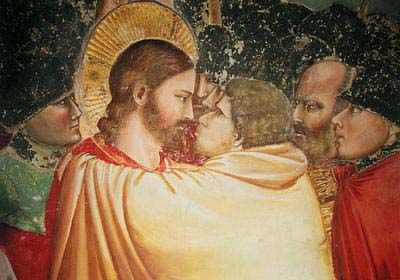
Never did the love of God express itself in a more pungent and tender way than when Our Lord spoke to Judas in the Garden of Olives. The guards did not know how to distinguish Our Lord from St. James the Greater who was very similar to Christ. So, they needed someone to unmistakably point Him out so they could take Him prisoner. Judas agreed with the Pharisees to deliver Our Lord for the price of 30 silver coins. The arranged sign of recognition was a kiss.

The kiss of Judas by Giotto
"With a kiss you betray the Son of Man?"
When Judas approached Our Lord to kiss Him, Christ said to him: “Judas, with a kiss you betray the Son of Man?” He allowed Judas to kiss Him. He could have easily prevented that scene. The power to stop it was not lacking to Him.

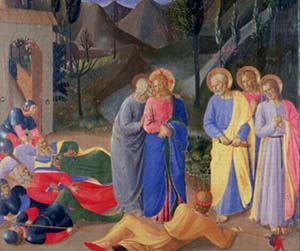
Indeed, a few moments later, when the guard asked Him: “Are you Jesus of Nazareth?” He answered: “I am.” After He spoke those words, all the guards fell with their faces to the ground because they could not bear the majesty of His Person. He could have averred Judas from his purpose with a simple gaze. But He did not.

He said: “Judas, with a kiss?” Each word was simultaneously an act of love and of wrath. “Judas, with a kiss?” That is to say, “Judas, you chose the symbol of friendship and love to come to betray Me.” “You who bring your face close to Mine, do you not remember all the graces I gave you? You whom I consecrated Bishop some hours ago…?” In that act, Our Lord reminded Judas of all the good he once had. It was, therefore, a supreme act of love.

But Our Lord added these words: “Do you betray the Son of Man?” Christ also brought to his attention the enormity of his ignominy. In fact, nothing could be more infamous than that treason, precisely because of its injustice. One friend owes friendship to another. Instead, Judas had hatred for Him. Further, Judas simulated the appearance of friendship to make the worst possible action. In that action, evil was multiplied by evil, making his act of betrayal particularly repulsive.

Ego sum, by Fra Angelico
The soldiers fall powerless at the words of Our Lord
It was not a simple treason: Judas was delivering God Incarnate to death… Further, Our Lord knew that Judas was planning such a betrayal and, in the name of mercy, did not send him away, but remained silent. To the crime of delivering Jesus Christ to Deicide, the traitor added the abuse of His mercy and silence.

I believe that in all of History nothing was more terrible than that recrimination. He was offering Judas the grace of repentance. If Judas would have repented, who knows what would have happened? He could have had a most edifying life and death. But he rejected that last sublime invitation. From that moment on, the hatred of God fell directly upon him.

The justice of God acted in such a way that Judas’ name became synonymous with the ultimate degree of infamy. When someone wants to throw the vilest possible epithet at a person, he calls him a Judas. This is how the action and very person of Judas became execrable to all.

Describing Hell in his famous work Divine Comedy, Dante Alighieri places Judas at the lowest level, in the very mouth of Satan, being eternally gnawed by him. It is an unspeakable torment: No one even sees his face but only the despairing movements of his legs that protrude from Satan’s mouth.

We know how Judas ended. After the betrayal, he went back to the Pharisees to return the 30 coins, but no one wanted that cursed money. He left the Sanhedrim and wandered in torment for a while through the city. Finally, he found a rope and hung himself on a fig tree. He judged himself, knowing that he would go to Hell, the place he wanted to be. It was a choice made for all eternity.

Thursday, March 21, 2013

Favorite Poetry: Batter My Heart

While doing English 12 work today I learned about John Donne, about whom I had previously known very little.  I was struck with the selections of his poetry in my textbook, though, and I think I shall look for more.
This particular poem I especially liked for its intensity, almost violence.  I also love the marriage/love imagery - as a "wannabe nun," I'm always a sucker for lovers' terminology applied to the spiritual!

I could almost use this poem as a prayer.  Is that "allowed," do you think?

via Google Images

Batter My Heart
By John Donne
 
Batter my heart, three-personed God; for you
As yet but knock, breathe, shine, and seek to mend.
That I may rise and stand, o'erthrow me and bend
Your force to break, blow, burn, and make me new.
I, like an usurped town, to another due,
Labor to admit you, but oh, to no end;
Reason, your viceroy in me, me should defend,
But is captived and proves weak or untrue.

Yet dearly I love you and would be loved fain,
But am betrothed unto your enemy;
Divorce me, untie or break that knot again, 
Take me to you, imprision me, for I,
Except you enthrall me, never shall be free,
Nor ever chaste, except you ravish me.


Isn't it striking?  *sighs in poetical bliss*
Incidentally, do any of you know anything about Donne?  Have any favorites you could recommend to me? Do tell!

Thursday, March 7, 2013

Of Convents and Clouds

I believe I owe my faithful readers (no posts in over a week, yet I just broke 8000 pageviews!) a bit of an update.  You see, I just haven't been able to come up with quality posts lately.  I'm not sure why.  Sometimes as I'm falling asleep I mentally write The Post of the Year, but by the time morning comes the idea has either been forgotten or has lost its luster.  Why is night such an exaggerated time?  People are always more emotional, more ambitious, and even more open at night.  I'm sure there's a reason for that, and I should very much like to know what it is.

(slightly creepy super-edited photo by me)
 So what have I been doing with my time lately?  Reading good books and indifferent ones, redoing algebra tests over and over till I have the problems memorized, trying (and mostly failing) to keep Lent properly, writing book analyses and doing tests on medieval and Elizabethan literature.  Also stalking people's tumblrs and crying over documentaries on The Lord of the Rings, but I rather prefer to ignore those bits.  Most importantly, I've been preparing for a Very Significant Visit to a certain convent.  Early tomorrow morning - so early that the stars would probably be out, if it weren't for the fact that it'll be cloudy - I shall be dropped off at the airport by my dad and thus embark upon my first trip alone.  Really, my first anything alone.  I'm not really scared, but there is a slight nagging in the back of my mind that's saying don't you dare mess up or so help me...

I love plane flights.  I've been on quite a lot, compared to most people, for which I am quite grateful. From the US to Germany, Germany to Scotland, back to the US, Virginia to Pennsylvania and back, and now this.  I'm not really sure what it is about flying that I like so much.  Probably it's just that - the fact that I'm flying.  Seeing cars turning into insects and rivers into threads, then the whole earth becoming a patchwork quilt, till finally you disappear above its curve into clouds that make a sort of fairy mockery of land - banks of vaporous continents, sky like oceans between them.  It's lovely.  And if you have the good luck to be flying at sunset (which I won't, this time), it's even better.

(photo by me)
But flying's not even the best part, because after all that, I shall arrive at a tiny little airport in the middle of New York and be met by smiling Sisters in graceful habits.  I'll be taken to a beautiful convent with Our Lord residing in a chapel a few yards away. I'm going to spend a whole week living a life I've dreamed about since I was six.  "Excited" doesn't even come close to describing my emotions.

~:~:~:~:~:~:~
 
Well, that got a bit out of hand.  I usually try not to spill myself out so much, but I think I'll let it go for now, because without the spilling this wouldn't be much of a post, would it?

So you won't see me for another week - not that it'll make a difference, as you usually don't see me for weeks at a time, anyway.

I'll be praying for you all from my convent chapel!

Sunday, February 3, 2013

Septuagesima: Preparing for Lent

This is a bit late, seeing that Septuagesima started a week ago, but better late than never, right?

"So," you ask, "what on earth is Septuagesima?"  You've probably guessed from the title that it has something to do with Lent.  See, traditionally there was no "ordinary time," but Sundays after Epiphany, Septuagesima season, and Sundays after Pentecost.  These seasons emphasize that there is no such thing as "ordinary" in the Church.  Septuagesima is a three-week period between the last Sunday after Epiphany and Ash Wednesday - a time of anticipating Lent and beginning to prepare for it.  Just goes to show how intense Lent is really supposed to be...

"Okay," you say, "so it's a time of preparation for Lent.  But what in heaven's name does it mean?"  Well, the word "septuagesima" means "seventieth." The season consists of three Sundays, as I said, named, respectively, Septuagesima, Sexagesima, and Quinquagesima.   (Those are really fun to say. )  So since the first one means "seventieth," it follows logically that the next two mean "sixtieth" and "fiftieth."  If you know any Latin, you probably figured that out.  Supposedly Septuagesima Sunday is "roughly seventy days before Easter." (source)

Traditionally, during Septuagesima the priest's vestments change to purple and the Gloria isn't sung again until...um....either Laetare Sunday or Easter.  I'm not sure which.  *blushes*  It's a good time to start "training" for Lent by making more sacrifices and generally getting your soul in good shape for all the self-denial you'll be practicing in the coming weeks.  I mean, really, isn't it much easier to eat small meals and give up sweets if you've already been cutting back?

This is also the perfect time to plan out your Lent: what you'll give up, what prayers you'll say, what spiritual reading you'll do...that sort of thing.  Also, cleaning.  I'm certain that it's easier to keep your soul clean if your room/apartment/house is clean.  Really.  Here's a little thing my mom did that's really helping me already: she simply took the lace cloth off of the mantle.  Our mantle is now bare except for two statues and two electric candles.  (I know you're cringing about the electric candles.  So am I, but it's better than nothing.) It reminds one of the altar on Good Friday. Every time I glance at that room, I see the bare mantlepiece and I remember that it's nearly Lent.  It's quite exciting, actually.

Sorry about the slightly random picture.  I typed "septuagesima" into google images and this is what came up. :)

What are you doing for Lent?  Did you know about Septuagesima before now?
Related Posts Plugin for WordPress, Blogger...